London, England
The ship was tied up in the Thames River in Greenwich
outside of London. We spent 3 days there because this was the
turn-around point on the cruise where the people on the first
cruise got to spend their last day on the ship while touring the
port before leaving the next morning on the turnover day, then
the new people had a day in the port as well. We made good use
of this time and saw quite a bit of this interesting city of contrasts.
This was a new port for us.

We arrived early in the morning and tied up to this floating dock
in the Thames River.

But first lines were attached to buoys at the bow and stern.


It was interesting to watch how our ship was secured and also
the full moon was setting.

The sun hit the iconic London skyline.

We were off the ship early. This high capacity ferry tied to the
opposite side of that floating dock
and it was a quick ride to the dock once it was loaded. A couple
of times there was standing room only.

The Cutty Sark Clipper Ship, now a museum, was on display right
next to the dock.

Our first adventure was a walk up a hill to the Greenwich Observatory.
Looking back toward The Thames is the Queen's House and the Royal
Navy College.

The Queen's House is a museum and art gallery today, but various
queens over the centuries have occupied this house.
Note that the Royal Naval College buildings do not block the Queen's
House view of the river.
 
This is the location of the Prime Meridian where the 24 hour meridians
begin and end. Ginny was in 2 time zones.

The Observatory is at the top of the hill. It was not open when
we arrived. We thought that we'd come back, but we did not.
 

Our big adventure the first day was a trip to Kew Gardens.
We took a train and then walked through this neighborhood to get
there.


There were lots of school groups there, each with their teachers
and a garden guide.
There were lots of outdoor gathering spaces where the children
could stop for activities and lessons.


This unusual structure housed an arid landscape, which was protected
from the copious London showers.


Pitcher plants and other carnivorous plants were in a different
building.


The huge Victorian lilypads from The Amazon were in a greenhouse
and two workers in waders were trimming back the jungle. They
had the small plastic boats for keeping the trimmings, but they
had laid a tool on one of the lilypads for safekeeping.
 

Big Ben is at one end of the Palace of Westminster. It was completed
in 1859 and is a UNESCO World Heritage Site.
The 4-faced clock still uses the original mechanism and has 5
bells. The Great Bell weighs 13.5 long tons (13.7 tonnes; 15.1
short tons). There are four quarter bells, which chime on the
quarter hours.


London is a city of contrasts from ancient to modern.


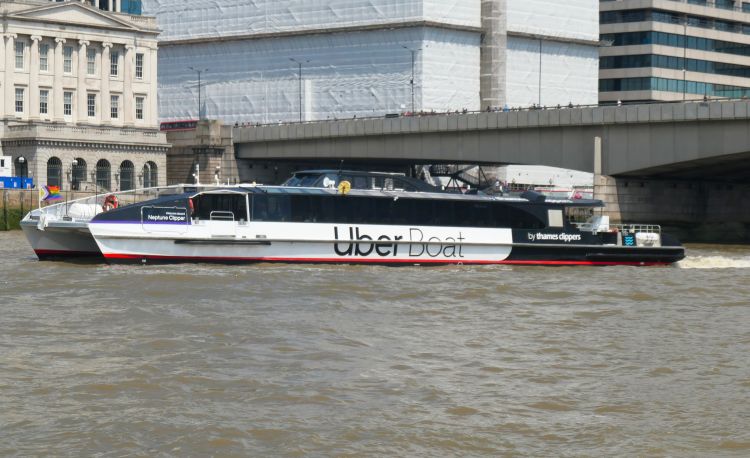
We rode on one of these low ferries for a different view of the
city.

Low bridges were the norm.

We went under London Bridge and fortunately, it was not falling
down as the old nursery rhyme states.


A city of contrasts...

We disembarked near London Bridge and we walked over it.
 
There was a lot of traffic--both foot and vehicular.


Potters Field Park was on the other side of the bridge. Ginny
wanted to see if it should be included in her wild gardens presentation.
It was okay and certainly better than a 100% mowed lawn, but it
needed some attention.

We were out early the next day and we did like this wild garden
near the ship.
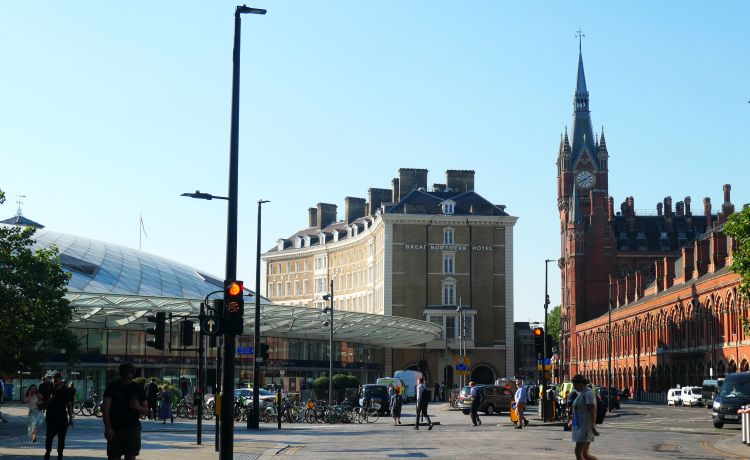

Our goal for this day was to see the redeveloped King's Cross
neighborhood, which used to be a blighted area where they had
stored coal in huge silos and it was called the Coal Drops Yard.
Here's what Ginny says about it in her native gardens presentation:
More than 40% of the 67-acre Kings Cross development is open space.
A new network of streets and footpaths lead through new parks,
gardens and leafy squares. Regent’s Canal also flows through the
heart of the neighborhood. More than 400 new trees were planted
and in many places, walls and roofs are greened. King’s Cross
is now a lush, green neighborhood, rich with natural life.

We came back to this natural area later. Note the big round buildings.
These had been the coal silos. They kept the fancy framework and
build high-end apartments where he coal bins had been.


Deep bioswales or rain gardens line most streets. They were built
with curb cuts so they absorbed the stormwater from the streets.
This measure reduces the risk of flooding during high rain events.

The Regents Canal had a self-operated lock to get the barges and
boats to the higher level.

Elevated walkways with gardens and seating were on top of some
shops.

Here's an outdoors restaurant with extra large umbrellas.

Shops and a plaza are at a lower level.

 
Google Deep Mind had an office space here.

 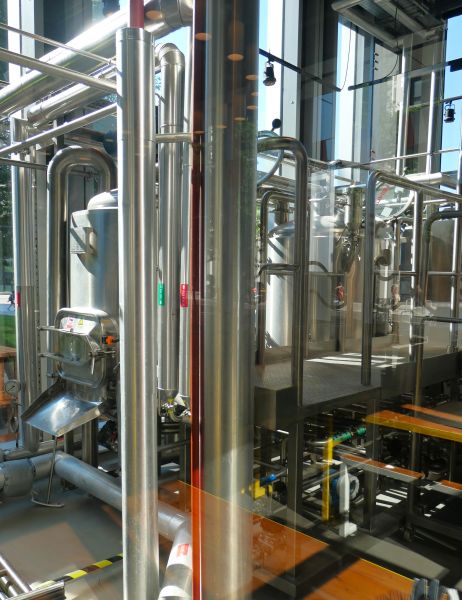
A local brewery

It was closed when we were there.


One of the bins was made into a public space and performance venue.
 

We walked along Regent's Canal. Many people live aboard these
river barges.
 
What could be more British than walking two Corgis along the Canal?

This Moorhen deliberately threw this plant stalk over the cascade.


The Canal got wider as it approached the Thames River. Some of
the river barges were businesses, while others were educational
centers.

A well-used water feature.
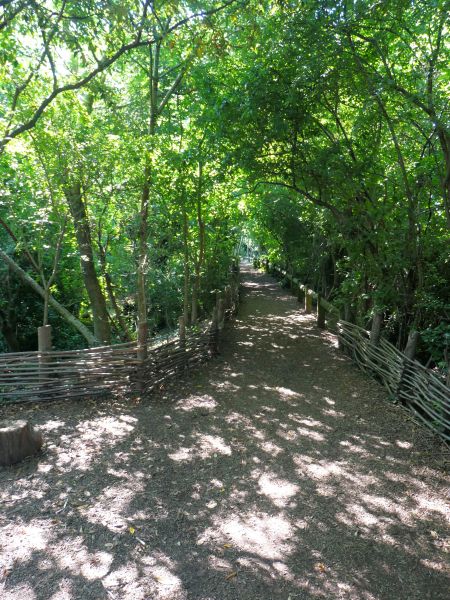 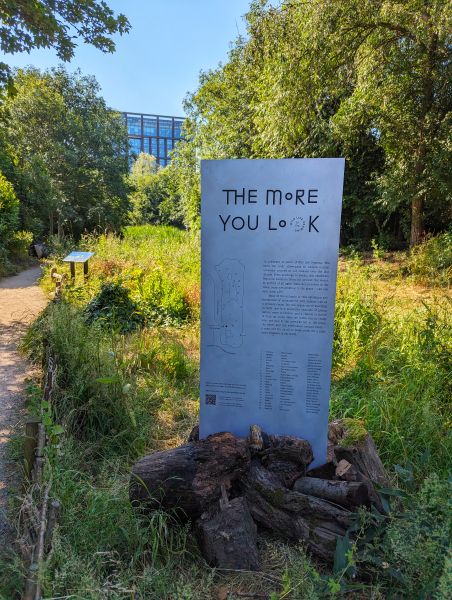
We walked in the wild area where there are trails, signs, a pond,
and more. While we could stil hear the city noise, it was muted
by the trees.

A Moorhen nest with maturing chicks was in the middle of the pond.


We are on the London side of The Thames River.
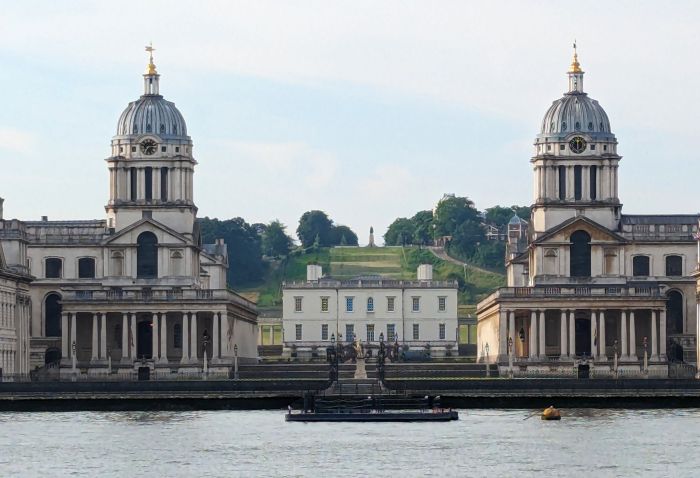
The Queen's House and the Royal Naval College buildings...
 
We went through this gazebo to walk on a huge raised mound called
Mudchute Park and Farm, because it was where silt from the river
was dumped. Now it's used for community gardens, raising livestock,
and other farming activities.


We then walked along the river side and along some of the canals.


Floating gardens were located in some of the side channels. They
never need irrigation; they provide habitat; and they remove nutrients
from the water.

A Cormorant dries its wings near one of the floating gardens.

We had a lovely conversation with this group. The flag is to cheer
on their favorite football (soccer) team.

The people here work hard to keep this patio garden looking good.

Then we walked under the river to get to the ship on the Greenwich
side.

It was a bit intimidating to know that The Thames River is all
around you. There were elevators stairways on each end.

We left late that afternoon. The glass dome structure in front
of the Cutty Sark Clipper is the housing for the elevator and
stairway for the tunnel under the river.

The Millennium Dome was built to welcome the 21st Century at great
expense. The 12 yellow towers hold the Teflon-coated fiberglass
cloth dome. In 2005 it was converted to an arena and it's now
called O2. It's located inside a bend in the river, so there is
water on three sides.

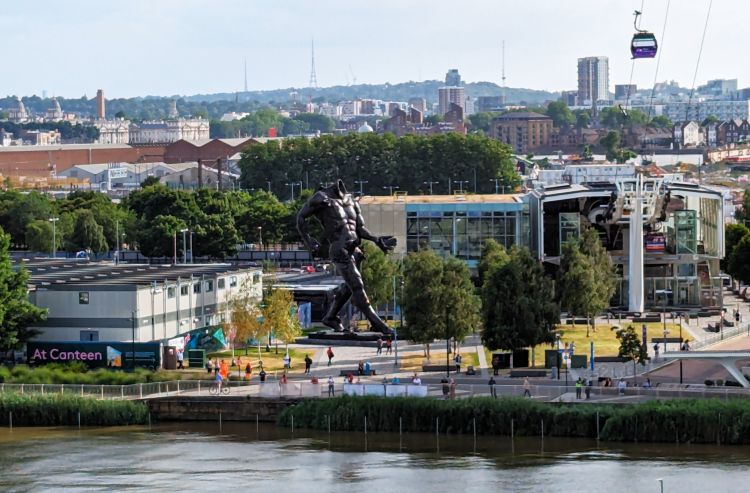
A giant, headless walker statue looks like he's heading toward
the cable car terminal.

With tugs on our bow and stern we slowly made our way through
the Thames Barrier, a retractable barrier system built to protect
Greater London from exceptionally high tides and storm surges.
And then we were on our way to Bergen again. We
loved this Into the Midnight Sun Viking adventure.
|